What a Puerto Rican who refused to speak English can teach every foreign brand trying to reach America, and what he can't
scroll ↓
Act One
The Wall
Between "Macarena" (1996) and "Despacito" (2017)
no predominantly Spanish-language song reached #1 on the Hot 100
1 year
261
Latin songs charted on the Hot 100 in the 2020s alone
vs 80 in the 2010s · 36 in the 2000s · 5 in the 1990s · 1 in the 1960s · 1 in the 1950s
Billboard Hot 100 chart entries, any position; author-compiled from Billboard archives · compiled count, not official Billboard aggregate
The Shift
68 Million
Between 2000 and 2024, the US Latino population nearly doubled, growing from 35.3 million to 68 million. That figure represents one in five Americans, with a median age of 31, eight years younger than the national median, meaning Latinos disproportionately occupy the prime music-consumption demographic.
US Census Bureau, Pew Research Center
In 1990, the map had a simple shape: 86% of US Latinos lived in nine states. California, Texas, Florida, New York, and five others accounted for nearly all of it. By 2020, that concentration had dropped to 73%, and 15 states had surpassed one million Hispanic residents. Atlanta's Hispanic population grew nearly 11-fold. Nashville shifted from under 3% to over 10%. North Dakota saw 148% growth in a single decade. Each new cluster generated playlist placements and recommendation-engine surfacing in markets where Latin music had never appeared before.
Pew Research Center, US Census Bureau
The audience outgrew the diaspora that seeded it. Luminate research found that 40% of Latin music fans in the US do not identify as Hispanic, and 20% of those non-Hispanic fans speak no Spanish at all. By the early 2020s, the listenership had decoupled from its Latino origins.
Luminate, September 2024
Five gates stood between a Spanish-language song and the Hot 100: format-segmented radio, label A&R, retail distribution, chart methodology, and the English-speaking professionals who controlled each one. Every gate optimized for English-speaking audiences. A song could be massive in Miami and invisible in Billboard.
FCC, Billboard
The gatekeeping collapsed in under three years. Streaming revenue overtook physical and download formats in 2015, became the majority source in 2016, and dominated by 2017. When Billboard integrated streaming into the Hot 100 (phased from 2012, completed by 2013), songs with massive engagement but zero radio airplay could chart for the first time. The new channel did not simply add a distribution option; it dissolved the filtering layer.
RIAA, Billboard
Streaming removed the filtering layer for discovery. It did not remove radio promo budgets, touring infrastructure, or retail placement. A Spanish-language song could now chart without permission, but converting a chart position into sustained revenue still required the machinery that majors controlled. The wall fell unevenly: access opened, but the economics behind it did not automatically follow.
In 2015, Latin music generated $290 million in US revenue. By 2024, that figure had reached $1.42 billion, nearly five times the 2015 level, with market share rising from 3.5% to 8.1%.
RIAA Year-End Revenue Reports, Music Business Worldwide
No other genre is as platform-dependent. 98% of Latin music revenue comes from streaming, the highest share of any category and well above the 84% industry average. Physical formats account for just 1.3%. Latin music did not migrate to streaming; it was born there.
RIAA 2024 Latin Revenue Report
Act Two
Bad Bunny
His name is Benito Antonio Martínez Ocasio. He bagged groceries in Vega Baja, Puerto Rico, before becoming the world's most-streamed artist four times over. His mother taught English. He speaks it fluently, and hosted Saturday Night Live twice in it. The decision to perform only in Spanish was a choice, not a constraint.
Signed to Rimas Entertainment, a Puerto Rican indie label with a reported ownership arrangement far more favorable than the 15–20% a major label offers. He owns his masters and holds equity in the label. Forbes placed him at $66 million in 2025 pretax earnings.Forbes Highest-Paid Musicians 2025, Billboard
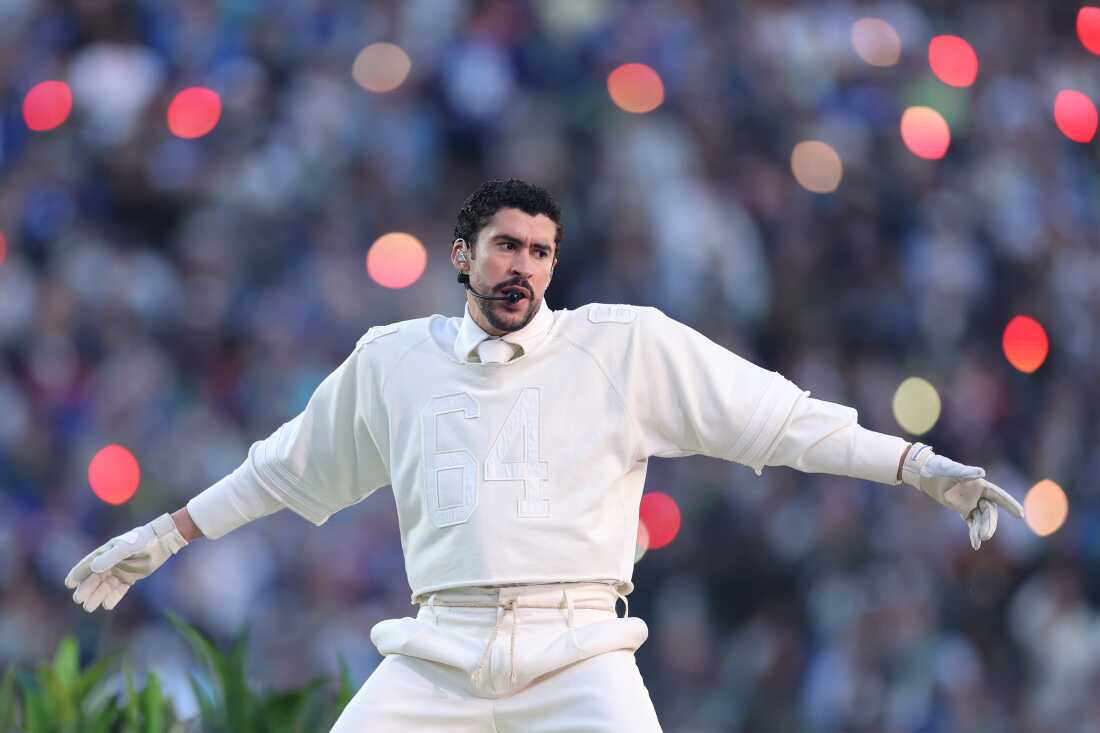
Apple Music Super Bowl LX Halftime Show · Levi’s Stadium, Santa Clara, CA · February 8, 2026
The pattern is predictable: every Super Bowl halftime performer sees a streaming spike within 24 hours. Rihanna's 2023 set produced a 640% Spotify increase. Usher's 2024 show drove 550%. Kendrick Lamar's 2025 performance yielded 175%. The question for Bad Bunny was whether an all-Spanish halftime would amplify or break the pattern.
Spotify, 24-hour post-performance vs. prior-week daily average
Bad Bunny's 2026 halftime, performed entirely in Spanish before 128.2 million viewers, generated a 470% overall Spotify surge within 24 hours. The catalog reactivation was more revealing: "Yo Perreo Sola," a track released six years earlier, spiked sharply across the catalog reactivation.
Spotify US Daily Top Songs, Rolling Stone
President Trump posted that "nobody understands a word this guy is saying… This ‘Show’ is just a ‘slap in the face’ to our Country." Streaming surged across platforms in the 24 hours that followed. The TPUSA-promoted alternative halftime drew approximately 5 million concurrent viewers against the broadcast's 128.2 million.
Truth Social via ABC News, CNN; Nielsen via ESPN
Social psychologists call the mechanism reactance: restricting a choice increases desire for the restricted option. Bad Bunny's US citizenship meant the backlash had limits; the amplified demand had no equivalent blowback. A non-American brand without that protection facing equivalent political controversy is more exposed; whether reactance converts to growth or boycott depends on how the brand is legally and culturally classified.
Act Three
What Transfers
Bad Bunny had 68 million Spanish speakers, rhythmic proximity to English, and a US passport. A brand entering the US from Asia typically has none of those. His advantages are enormous and mostly non-transferable. But some of what he did, how he built rather than what he had, resonates with tendencies we observed in Asian brands that made the crossing before him.
Three patterns in particular kept surfacing across cases that otherwise had little in common. Bad Bunny's career is the most visible example; the Japanese and Korean brands that preceded him in different categories are quieter ones. In each case, the brands that crossed over tended to keep their original format intact, build trust through a specific community-by-community sequence, and retain enough margin through channel ownership to fund the next stage of growth. None of those three alone explains a successful US entry. Together, they describe something closer to the conditions under which crossover became possible.
The original format. Bad Bunny refused to record in English. Yakult, a Japanese probiotic drink sold in a distinctive 2.7-ounce bottle with a crinkly red foil cap, arrived in the US with the same packaging it sells in forty countries, a size that violates every American convention for beverage sizing. Pocky, Glico's chocolate-coated biscuit stick, kept Japanese packaging through a decade-long US build. In each case, the brand carried its origin visibly rather than adapting to local convention. But whether that choice works depends heavily on how American consumers already feel about the country in question.
Yakult Annual Reports; Glico USA
Japanese brands had a quality halo built by decades of electronics and automotive exports. Korean brands benefited from Hallyu, a cultural premium that made Seoul a referent for style and innovation before any single K-beauty product reached a Sephora shelf. Latin music arrived on the demographic engine described above. Keeping the original format worked in each of these cases because American audiences already associated the origin with something desirable. That favorable association is not universal, and it is not evenly distributed across Asia.
Widely documented in country-of-origin branding research; see Aichner 2014 for a review
Chinese consumer brands entering the US in 2026 face a fundamentally different situation. Tariffs, political scrutiny, and low baseline trust among non-Chinese American consumers do not dissolve because the packaging is authentic. Miniso understood this early: it presented itself as Japanese for years because it recognized that Chinese provenance, in its category, was a commercial liability. Its 2022 apology resolved the ethics of that decision, but the underlying problem remains. The Yakult and Pocky examples above relied on a precondition, favorable country-of-origin perception, that Chinese brands currently do not share. Which means the playbook for Japanese and Korean brands does not reverse-engineer into a playbook for Chinese ones. How to build when provenance works against you is a harder question, and one the available case studies do not yet answer well.
Miniso Weibo statement via Vice, 2022
The sequence. Bad Bunny moved from SoundCloud to Spotify to radio to the Super Bowl. Each stage earned the audience that made the next possible. The Latino audiences who engaged first were not a preliminary step to move past; their streaming activity generated the playlist placements and recommendation-engine surfacing that brought the music to broader listeners. A similar sequence, ethnic audience first, then crossover, appears across the consumer brand cases we examined.
Spotify; Billboard
Yakult arrived through Asian grocery in 1999, pivoted to Hispanic supermarkets by 2005 (leveraging recognition already built in Mexico), and reached national grocery only in 2007. Pocky spent a full decade in Asian specialty stores before Walmart and Target. Boba, the Taiwanese tea drink, moved from Taiwanese-American communities across pan-Asian networks, then into national grocery and chain retail. K-beauty grew from a 2-million-person Korean-American base to $2 billion in US sales. In each of these cases, the early base served as a proof of concept, evidence of demand that justified the next retailer's shelf-space bet.
Yakult corporate filings; Glico USA; Circana 2024; Specialty Food Association; Pew Research Center
The Asian-American population's apparent fragmentation (Chinese 5.4M, Indian 4.4M, Filipino 4.4M, Vietnamese 2.2M, Korean 2M, Japanese 1.5M) looks like a liability if you are trying to address it as a single market. But the brands that crossed over tended to treat each group as a discrete stage. Those that skipped stages, jumping from one audience to national retail without earning the trust of the ones between, often found that the reputation they bypassed was the part that mattered most.
US Census Bureau ACS; Pew Research Center
The channel. How much of a product's retail price a brand actually keeps depends on how many intermediaries stand between it and the buyer. Through the traditional US chain (importer, distributor, retailer), an imported brand retains fifteen to 30 cents on the dollar. Sold direct, it retains sixty to 80. That gap determines whether a brand can reinvest in growth or remains permanently dependent on someone else's shelf space and someone else's terms. Rimas Entertainment's reported ownership arrangement gave Bad Bunny the favorable version of that economics in music. Anker, the Chinese consumer electronics company best known for phone chargers and portable batteries, demonstrated it in physical goods: it built a multibillion-dollar US business almost entirely through Amazon, bypassing traditional retail distribution.
Yakult opened a manufacturing plant in Fountain Valley, California in 2014, after fifteen years of proving demand through channels it controlled. The plant is an economics story: the moment Yakult stopped paying for someone else's capacity and started building its own. The brands that stayed dependent on other people's infrastructure were also dependent on other people's priorities. That dependency compounds the same way ownership does, in the wrong direction.
Yakult corporate filings
Yakult executed all three. It arrived through ethnic grocery, worked the audience sequence over fifteen years, kept the bottle unchanged, built its own manufacturing when demand justified it, and became a national phenomenon when a Netflix film turned its conspicuous distinctiveness into the crossover mechanism. In 2018, To All the Boys I've Loved Before featured the little red-capped bottle in a pivotal scene, calling it a "Korean yogurt smoothie." Wrong country, wrong category; audiences recognized it immediately, and daily US sales reportedly jumped from roughly 118,000 bottles to 378,000 within a year. By 2022, the company was selling an estimated 632,000 a day. The company never translated the formula, and never needed to.
These three patterns are not a formula. They assume an origin that carries favorable associations, a base large enough to serve as a first audience, and a margin structure that can eventually support owning the channel. Bad Bunny had all of those, plus 68 million Spanish speakers and a streaming infrastructure that had already dissolved the gatekeeping layer. Most Asian brands entering the US have some of those conditions but not all. The useful question is not whether a brand can replicate his path, but which of these conditions apply to its specific category, origin, and economics, and which do not.
Act Four
Your Move
In the cases examined, the brands that accommodated all failed. The Korean pop singer BoA (Kwon Bo-ah), one of K-pop's earliest crossover attempts, recorded an entire American relaunch album in English; it reportedly sold fewer than 10,000 copies in the US over its full run (single source; secondary). Miniso built a $7.6 billion business by presenting itself as a Japanese brand, then formally apologized in 2022 for doing exactly that. Each diluted its offering to clear a gate that no longer exists.BoA album sales: Billboard via Wikipedia; Miniso apology: Weibo statement via Vice
Yakult kept a 2.7-ounce bottle in a market that supersizes everything. It took eight years to reach mainstream grocery shelves. It took nineteen years to build a US factory. And by the time a Netflix film made the little red-capped bottle famous, the company was selling over half a million of them a day.
A man from Vega Baja sang in Spanish for 128.2 million Americans. He had a demographic engine most brands from outside the US will never match. But the choices that mattered were his: keep the original format, build through the audience sequence, own the channel. Whether those conditions hold for a given category, origin, and margin is the question worth carrying forward.