The Asia Aisle
Elix Healing sells personalized Chinese herbal formulas for hormonal health to American women who have mostly never used Chinese medicine. The company raised $2.7 million five years ago and has not raised again. Third-party data suggests an annualized run rate above $25 million.1
The question the company answers is one that any founder carrying a traditional practice into a skeptical market will recognize: in what order do you introduce a tradition your customer doesn't trust yet? Elix chose symptoms first, heritage second, clinical evidence third. Here is what that sequence looks like in practice.
SCROLL TO BEGIN
Traditional Chinese Medicine has been available in the United States for decades. What has changed is who is buying it, and how. The brands operating in this space have taken notably different approaches to the same problem: how much of the tradition does a brand preserve, and how does it reach consumers who have no prior relationship with it?
DAO Labs partnered a consumer executive with Dr. Eric Karchmer, a medical anthropologist with a PhD and Fulbright who had studied TCM in China for over a decade. They renamed classical formulas for Western goals ("Gui Pi Tang" became "Mental Tranquility") and reformulated bitter decoctions as flavored effervescent powders.2
Third-party tracking data suggests e-commerce revenue has contracted significantly, from approximately $599,000 to an annualized $238,000.3 The credentials are real; they have not yet translated into consumer traction.
WTHN raised $12.1 million, with a $5 million Series A led by L Catterton (the LVMH-backed fund). Gwyneth Paltrow invested in the 2019 seed round. The brand opened acupuncture studios in Manhattan, placed products in Ulta and Goop, and reports 200+ retail doors and 40% wholesale growth.4
WTHN has real momentum. Its approach centers acupuncture studios and standardized product lines ("Prevent, Heal, Glow") rather than individualized herbal formulation. The founding team does not appear to have Chinese heritage. The model works commercially; it occupies a different position than Elix on the authenticity-accessibility spectrum.5
Those are the two most visible players. But the landscape is wider than a binary suggests. NOOCI, founded in 2022 by Hong Kong-born Stephanie Tan, sells $45 standardized TCM capsules and occupies the closest position to Elix: a Chinese-heritage founder bringing herbal supplements to a Western DTC audience, though without personalization. Solstice Medicine has distributed patent medicines through Asian groceries for over 40 years. Health Concerns, founded in 1984, was the first company to manufacture Chinese herbs for U.S. practitioners and still sells primarily through the practitioner channel. ActiveHerb imports cGMP-certified formulas at commodity prices. YINA is a practitioner-founded artisan skincare line doing under $500,000.3
Between them, these brands represent at least five approaches to the same problem: the practitioner channel, the import model, the heritage distributor, the luxury artisan, and the wellness rebrand. What Elix attempted was different from any of them.
The quadrant tells the story. Several brands have built real businesses in this space, with different tradeoffs. WTHN has money and distribution. DAO Labs has scholarly depth. NOOCI has a Chinese-heritage founder and DTC positioning. What none of them has done is combine individualized formulation with mainstream consumer reach and clinical evidence on finished products. That is the position Elix is attempting to hold.
Why the quadrant is empty
The structural reason is visible in the competitive landscape. TCM's therapeutic logic depends on holistic pattern diagnosis, individualized formulation, and extended timelines. The standard efficacy window for herbal treatment of menstrual conditions is three full cycles, roughly 90 days.6 Simplify any of these to speed up mainstream adoption and the therapeutic logic starts to thin. Preserve all of them and the addressable market shrinks to a niche that, in the United States, reaches about 2.2% of the adult population annually.7
This is the core tension, and it is not unique to TCM. Ayurvedic medicine, traditional Korean medicine, and every other system built on individualized diagnosis and slow treatment cycles faces a version of the same tradeoff when it tries to reach consumers accustomed to standardized products and rapid outcomes. Most brands in the space have prioritized one side of that tradeoff. The question is whether both can be held at once.
The Founder
Lulu Ge was born in a hospital in Hunan province that her grandfather administered. Traditional Chinese medicine was part of her household, woven into how her family navigated care across generations.8
After discontinuing hormonal birth control in her late twenties, Ge experienced cystic acne, migraines, and severe cramping. Three gynecologists offered the same intervention: go back on the pill. Through a family connection to a TCM practitioner, she tried a personalized herbal regimen instead. It resolved her symptoms within months.9
The gap she identified was specific. The diagnostic process that helped her, pattern-based assessment rooted in centuries of practice, was functionally inaccessible to Western women. Language barriers, opaque supply chains, and the specialized vocabulary of TCM diagnosis kept it out of reach for most consumers. Ge spent nearly two years validating the idea while still at her corporate job, talking to potential customers about whether they would trust a detailed health assessment and how Chinese medicine fit into their worldview. Early prototypes were bottled in plain brown glass with handwritten customer names on the labels.9 She drafted the business plan at Wharton, launched Elix in March 2020, and closed a $2.7 million seed round a year later from Tribe Capital and others.10,11
Ge built a DTC subscription business around three go-to-market choices, made in sequence. Each one addressed a specific barrier to selling Chinese medicine to American consumers. Each one also introduced a specific constraint. The choices are worth examining individually, because the same sequencing problem applies to any traditional practice entering a skeptical market.
The Elix website leads with outcomes, not tradition. The hero reads "Proven herbal care, tailored to your cycle," foregrounding efficacy and personalization before any mention of Chinese medicine. The color palette is warm lavender and cream. The CTA is "Discover My Formula," language that positions the consumer as the subject.12
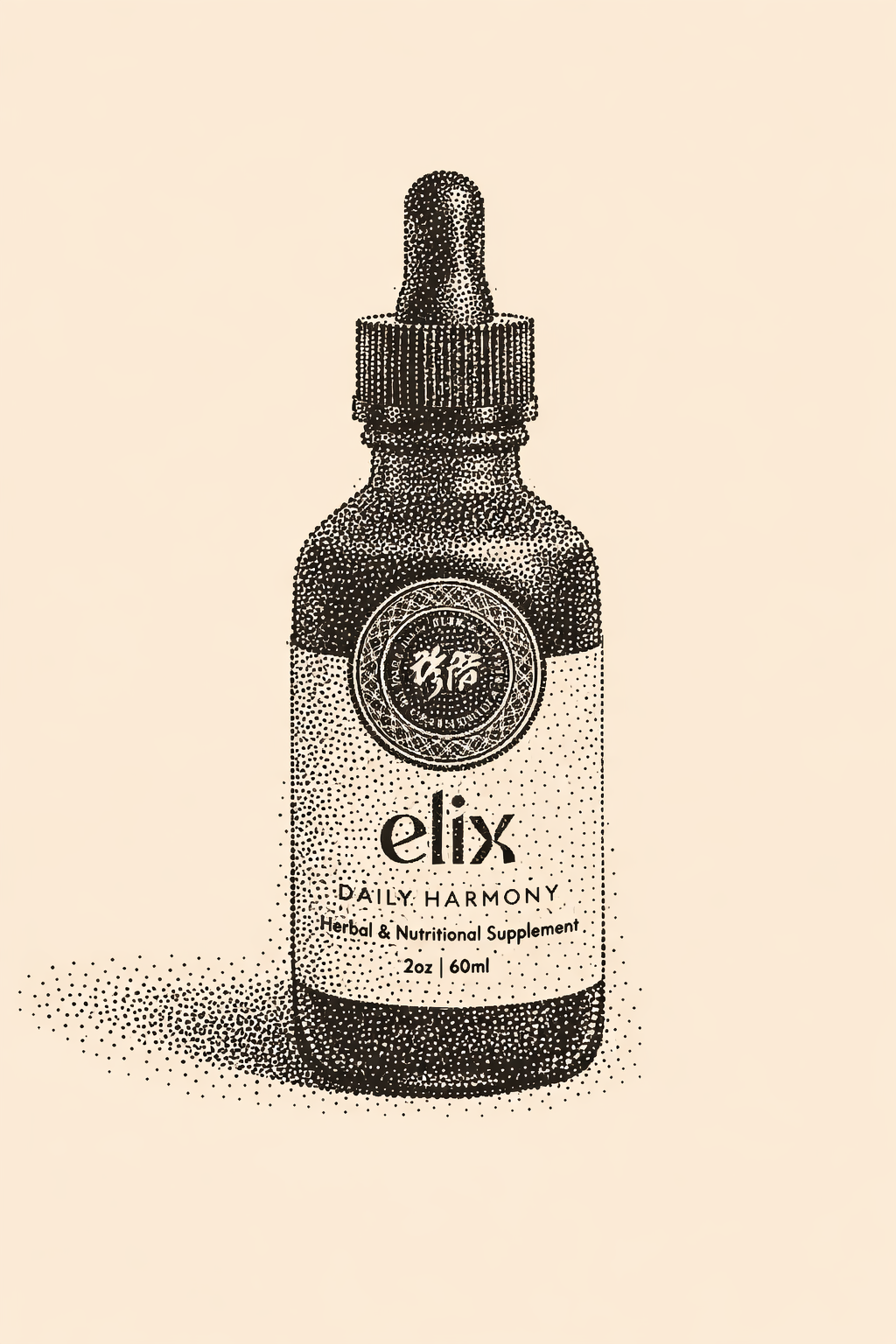
Scroll further, though, and the strategy reveals its layers. A section titled "5,000 Years of Ancient Wisdom" appears prominently, with herb photography (Dang Gui, White Peony Root, Motherwort) catalogued by Western benefit language: "menstrual harmony," "digestive support," "emotional balance." The product imagery features raw ginger, dried roots, and tincture bottles rather than the lifestyle photography typical of DTC wellness brands. Elix does not suppress its TCM identity; it sequences it, placing symptom-first framing at the entry point and tradition-first framing deeper in the scroll, after the consumer has already been given a reason to keep reading.
Research on TCM consumer adoption helps explain the sequencing. Only 45% of Americans are familiar with both acupuncture and Chinese herbal medicine. Just 30% believe TCM is comparable to Western medicine.13 Elix translates selectively rather than comprehensively: "root cause" instead of diagnostic terminology, "pattern of imbalance" instead of tongue-and-pulse language, "internal heat (inflammation)" with Western parentheticals trailing the TCM concept. The tradition is present throughout the site, but it arrives after the consumer's problem has been named in her own vocabulary.
What it solved: The entry barrier. A consumer searching "period pain relief" can find Elix without ever learning the phrase "Liver Qi Stagnation."
What it may cost: In TCM, the diagnostic language carries clinical meaning that Western equivalents do not fully capture. "Liver Qi Stagnation" and "inflammation" are not synonyms. How much of that distinction the personalization engine preserves behind the consumer-facing interface is difficult to assess from outside. There is also a regulatory dimension. Under DSHEA, Elix can claim "supports hormonal balance" but cannot claim to treat PCOS, endometriosis, or dysmenorrhea. Customer testimonials on the Elix website reference cancelling endometriosis surgery and PCOS resolving on ultrasound, which may constitute implied disease claims. The FDA issued enforcement actions against comparable companies in 2025 for this kind of language linked to purchase pages.29
The second move built diagnostic depth that competitors cannot replicate at their price point. The supplement personalization spectrum runs from generic (one product for everyone) through condition-specific and life-stage segmented, up to quiz-selects-preset at the high end. Elix sits above all of these, alone in the tier, operating as the only DTC brand with practitioner-designed custom formulation.14
Behind the accessible entry point sits a 50-question health assessment, including tongue photo analysis, that maps inputs to a TCM pattern diagnosis. From that diagnosis, practitioners select 10 to 18 herbs per individual and compound a custom liquid tincture. Formulas are reassessed quarterly as the patient's condition evolves.14
The granularity creates switching costs. A consumer who leaves Elix would need to find another provider capable of the same individualized formulation, and no DTC competitor currently operates at that depth. Elix has a 90% repeat purchase rate and roughly 50% of growth from word-of-mouth, metrics consistent with a product whose users become advocates.15 The company has also expanded into one-on-one consultations with licensed Chinese medicine practitioners, a move that deepens the clinical relationship and has significantly increased customer lifetime value.
Ritual: Published double-blind, placebo-controlled RCT. Seed: 20+ peer-reviewed publications.18
Three IRB-approved studies. Single-arm observational design, 42-65 participants, no placebo control.16
Heritage claims ("2,500-year-old formulas," "3,000 years of Chinese Medicine"). No trials on finished products.2,4
The third move invested in clinical evidence at a level no direct competitor has matched. Elix has registered three IRB-approved studies on ClinicalTrials.gov, targeting PMS, PCOS, and uterine fibroids.16 No other modern TCM consumer brand has invested at this level, and the consumer psychology research explains why it matters: a 2023 UCSD and Radicle Science study found that "clinically proven" is the single most important supplement purchase driver, with 76% of consumers placing it in their top three. The label doubles purchase intent and commands a 20%+ price premium.17
Elix can truthfully say "clinically studied" in a category where no direct competitor can. For the consumer comparing options, that distinction matters. The initial studies are observational (no control group), which is a common starting point for herbal supplement research. A double-blind, randomized, placebo-controlled trial would open the door to physician endorsement and the evidence-first communities that evaluate supplement claims by study design. The company's ongoing PCOS and fibroids studies suggest it is building toward that standard.
Elix does not disclose revenue, which is standard for a private company at this stage. The available third-party data and company statements point in a consistent direction.
Revenue estimates vary, which is typical for a private DTC company. Third-party transaction data from Particl suggests $13 million in a six-month window; earlier estimates based on headcount and DTC benchmarks placed annual revenue at $3 to $5 million.1,19 This piece presents both without adjudicating. What is clear: Elix has operated for five years on a single seed round, has a 90% repeat purchase rate, has completed nearly one million health assessments, and has not sought additional outside capital.15,20 The unit economics of a $48-per-month subscription with organic-heavy acquisition are sustaining the business without external subsidy.
Elix is operating in a window where three cultural forces are moving simultaneously, two in its favor and one creating friction. The timing is relevant because it shapes whether the company is pushing against the current or riding it.
TCM interest in the United States has spiked measurably. The TikTok hashtags #NewChinese and #SpiritualChinese exceeded 500 million combined views, with Chinese and Chinese-American creators at the center of the wave rather than Western wellness influencers repackaging the practices.21 Separately, the post-pill movement has become structural: the KFF Women's Health Survey found that 22% of women ages 18 to 25 now use fertility awareness-based methods, the FDA approved a black-box warning on Depo-Provera for meningioma risk in December 2025, and over 1,800 lawsuits are active against Pfizer.22 Both of these currents flow directly toward Elix's positioning.
The friction is geopolitical. 77% of Americans hold unfavorable views of China (Pew, 2025), though that figure has dropped from 83% in 2023, and the intensity of negative views has softened significantly among younger adults.23 Americans under 30, the demographic most aligned with Elix's customer base, hold the lowest rates of strong negativity. The 1980s Japan parallel is instructive: at the peak of anti-Japanese economic sentiment, Japanese cultural products gained mainstream market share simultaneously.24 Cultural products and geopolitical hostility do not always move in the same direction.
Lulu Ge's personal TikTok account has approximately 130,000 followers. The Elix brand account has approximately 9,200: a ratio of roughly 14 to 1. On Instagram, the dynamic inverts. The brand holds 150,000 followers; Ge holds 40,000.25
The operational implication is specific. Discovery and acquisition are founder-dependent; community and retention are brand-owned. If Ge stepped back, or if the algorithm shifted, Elix would lose its top-of-funnel while keeping its subscriber base. That is a manageable dependency, but it creates a natural ceiling on growth that the company will eventually need to address by building trust channels beyond a single person. Ge's grandfather's calligraphy is on the product seal. Her personal health crisis is the origin story. Her cultural fluency in both TCM and Western consumer language is the brand's most distinctive asset and its most difficult to replicate.9
A 2025 Business of Fashion report found that only 13% of consumers cite a brand's founder as a key purchase reason, versus 39% citing product performance.26 But that statistic describes established categories where credibility is assumed. In a category where the primary purchase barrier is "can I trust this tradition I've never tried," the founder's biography functions as the initial credibility source. The 14:1 TikTok ratio measures that dependency directly.
The natural hormone health information ecosystem is dominated by a small cohort of functional medicine voices who are not potential allies but direct competitors. Dr. Jolene Brighten (~619K Instagram), Alisa Vitti (FLO Living, ~300K combined), and Amanda Montalvo all sell their own supplement lines targeting the exact consumer Elix is trying to reach. Nicole Jardim and Lara Briden complete the cohort. None of them appear to actively recommend or mention Elix.27
Present at discovery. Absent in the education and validation stages.
Ecosystem gap analysis; influencer data from Instagram/HypeAuditor
The absence is structural, not incidental. These influencers have commercial reasons to exclude a TCM-based entrant (promoting Elix would cannibalize their own product revenue), methodological reasons (their audience expects the language of cortisol, insulin, and estrogen metabolites, not pattern diagnosis and Qi stagnation), and professional reasons (they cross-pollinate within functional medicine networks where Ge, as a founder rather than a practitioner, does not circulate).27
The typical information journey for a woman leaving hormonal birth control runs from TikTok discovery through influencer education to community validation to product trial. Elix is present at the first stage, where Ge's personal content provides the initial discovery, and benefits from word-of-mouth at the last. The middle two stages, where purchase intent is actually shaped, belong to competitors who have structural incentives to keep TCM outside the conversation. The brand's 50% word-of-mouth growth proves organic pull exists downstream. But scaling beyond that organic base may require building a parallel education ecosystem (TCM practitioners with social followings, integrative OB/GYNs, the #NewChinese creator wave) rather than trying to enter one where the established players sell competing products.27
Elix's Trustpilot distribution is bimodal: approximately 74% five-star, approximately 21% one-star, and a virtually empty middle.28
The five-star reviews describe significant symptom relief, often after years of failed conventional treatments. The vocabulary is clinical and personal: PCOS improved, pain from ten to three, life changing. The one-star reviews describe cancellation friction and fulfillment failures: charges after requesting cancellation, missing packages, pauses offered instead of termination, difficulty reaching customer service. The two populations share a review page but describe different companies, and their vocabularies do not overlap.28
The company has acknowledged the cancellation issue and says it is building self-serve cancellation per the FTC's "click-to-cancel" rule. As of February 2026, recent reviews still reference billing friction, though the volume of fulfillment complaints appears to have decreased from its late-2024 peak.28 For a brand where trust is the primary purchase barrier, this matters. The consumers most likely to research Elix before subscribing are the ones who will find the cancellation complaints. Resolving the friction would close the gap between what the product delivers and what some customers experience on the operational side.
Ge made three choices. She led with Western symptom language so American consumers could find the product. She built a personalization engine deep enough that switching to a generic alternative felt like a downgrade. And she invested in IRB-approved clinical trials, which no other DTC herbal supplement in the category had done.
Each choice also defines the next phase. The symptom-first framing brought consumers in; the opportunity now is to deepen how those consumers understand TCM over time, which the TikTok content and quarterly reassessments are already doing. The personalization engine created real switching costs; maintaining practitioner involvement at scale is the operational challenge that comes with that advantage.
The clinical evidence leads the category; a peer-reviewed publication or a larger randomized trial would move the needle with the medical professionals whose endorsement matters for the next ring of customers. And the founder's role as primary acquisition channel, the most visible of these dynamics, is also the one with the clearest path forward: the #NewChinese creator ecosystem and integrative practitioners represent a channel-building opportunity that did not exist three years ago.
The sequencing problem Elix solved is not specific to Chinese medicine. Any company carrying a traditional practice (Ayurvedic, Korean, Indigenous) into a mainstream market where that tradition is unfamiliar will face the same question: what do you say first, and what do you hold back until the customer trusts you enough to hear it?
Elix's answer was: the customer's problem first. The tradition second. The evidence third. That sequence got the company to profitability on $2.7 million. Whether it can carry the business to the next stage, past founder dependency, past subscription friction, into clinical credibility, depends on whether the choices that worked at this scale still work at the next one.
Sources