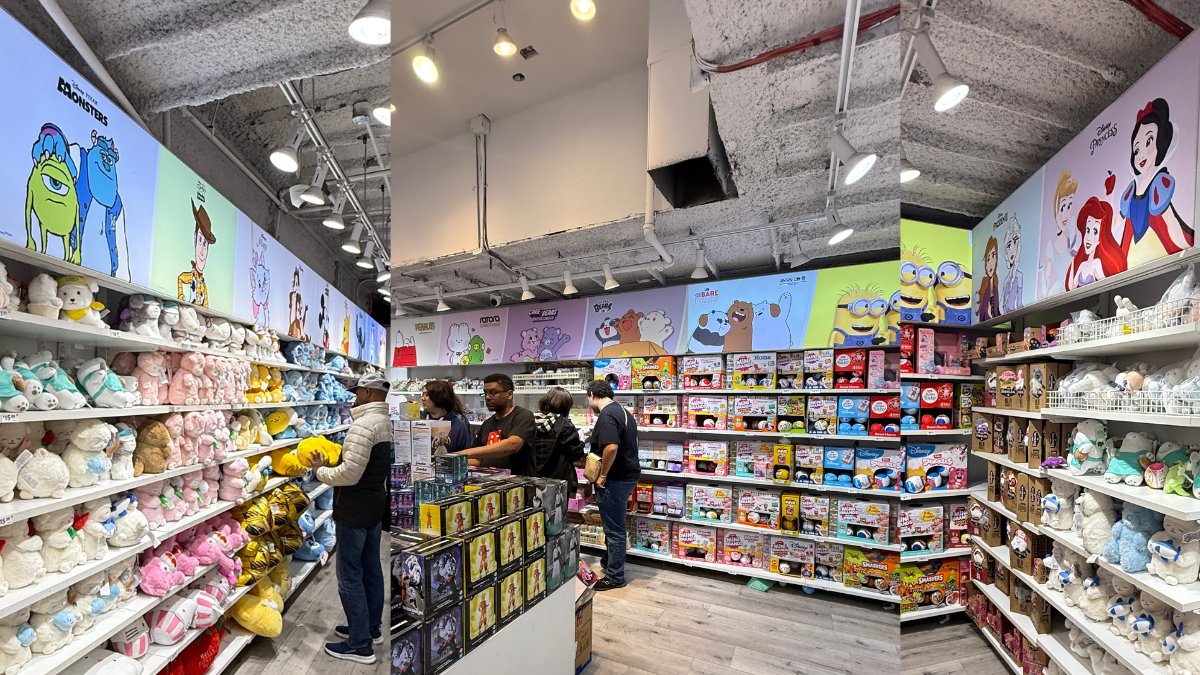
Interior of the Miniso store at 5 Times Square, New York. Disney Pixar Monsters, Care Bears, We Bare Bears, Peanuts, Disney Princess, Stitch, and Hello Kitty character walls surround the customer floor. The Miniso wordmark is not visible above the registers.
Asia Aisle · Brand Intelligence

The Borrow

Miniso, the second engine, and what the next 24 months will tell us.

↓ Scroll to begin
Inside the Miniso store at 5 Times Square, New York. Composite of three interior frames. Disney Pixar Monsters. Care Bears. We Bare Bears. Peanuts. Disney Princess. Stitch. Hello Kitty in the next aisle. The Miniso wordmark does not appear above the registers; it appears on price tags and baskets.

At Miniso's store at 5 Times Square, the lit signage above the registers reads Sanrio and Disney. The Miniso wordmark is visible but subordinate. In Santa Monica, where the 200th US store opened in August 2024, the arrangement is the same. Hello Kitty is the welcome. Stitch is on the column. Marvel runs the back wall.

Jack Ye (Ye Guofu), the founder and CEO of Miniso, has entered a market by borrowing twice.

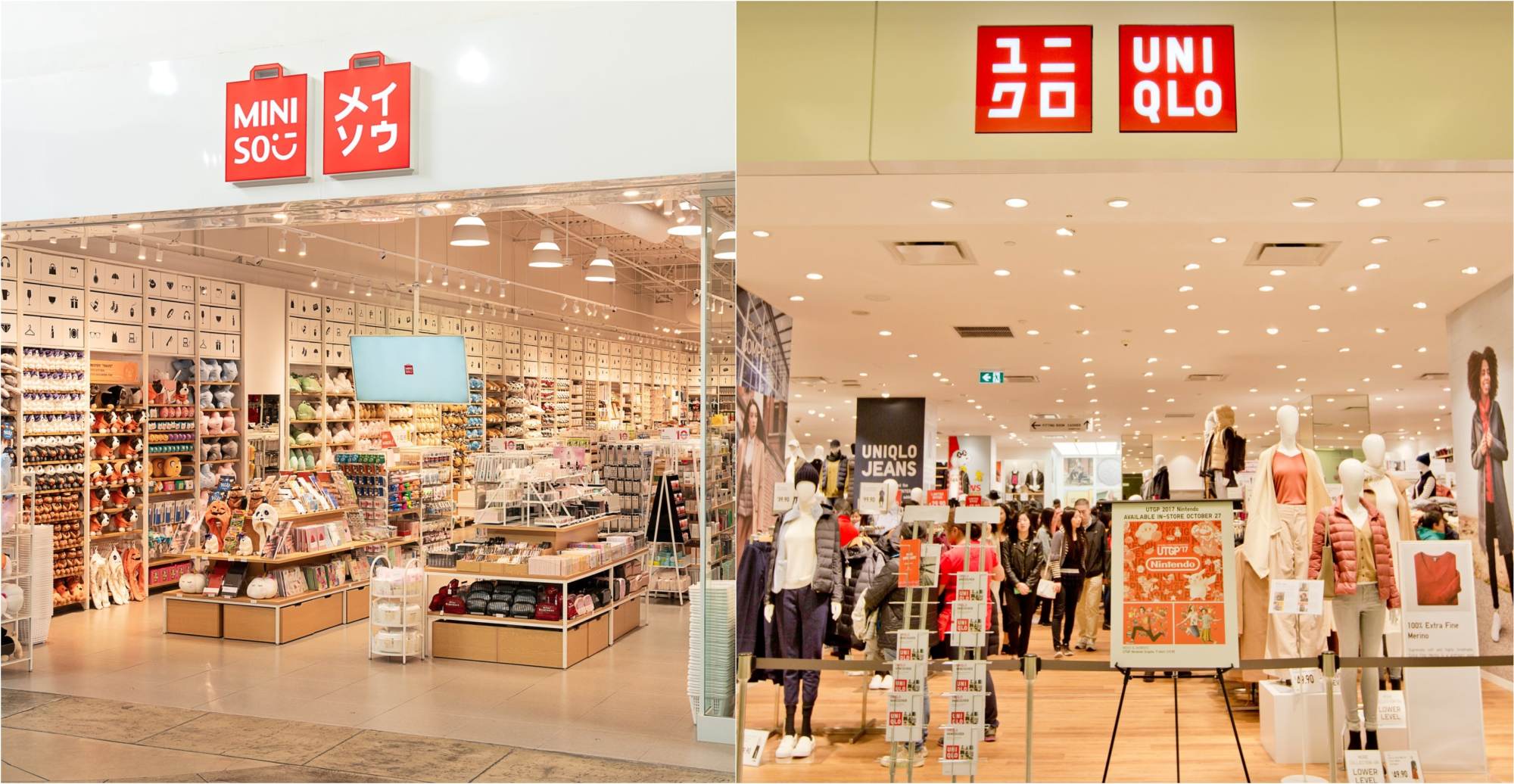
Side-by-side photograph of two storefronts. On the left, a Miniso store with two red shopping-bag-shaped signs above the entrance, one reading MINISO in white English and the other in white katakana characters. On the right, a Uniqlo store with two red square signs above the entrance, one reading UNIQLO in white English and the other in white katakana characters.
Miniso storefront, left. Uniqlo storefront, right. Same red. Same dual script.

In 2013, in Guangzhou, he founded Miniso, presenting it as a Japanese brand. The logo was a red square with white katakana, the angular Japanese script, echoing Uniqlo. He hired the Japanese designer Miyake Junya to legitimize the look. The product range was MUJI-style minimalism across the eleven everyday-goods categories MUJI itself runs. The average selling price was near $2, and the average basket was near $5.¹ The aesthetic placed a Chinese retailer in a market where Japanese design was already trusted. Customers shopped at Miniso the way they shopped at Uniqlo and MUJI. They walked in confident, without needing to know where the brand came from.

By 2019, Miniso was one of the largest Chinese physical retail brands in operation. The borrow worked. By the same year, the company was the defendant in more than forty design-similarity claims.

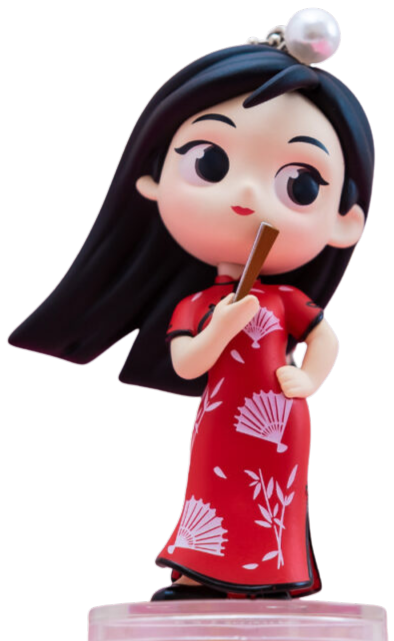
Miniso figurine of a young woman in a red qipao, mislabeled as Japanese geisha on Miniso social media in August 2022.
The figurine at the center of the 2022 incident. Chinese qipao, labeled as Japanese geisha by Miniso's own social-media account.

In August 2022, a Miniso social-media post labeled figurines wearing Chinese qipao as Japanese geisha, prompting immediate backlash at home. The qipao is Chinese. A Chinese retailer calling it Japanese, eighty years after the Nanjing Massacre and the Japanese occupation of China, was never going to land as a small mistake. On August 18, Ye apologized publicly, calling it a "wrong path in brand positioning." The next day, the Tokyo-based account TokyoFashion posted: "MINISO – the fake 'Japanese brand' that used to have a small store near Harajuku Station Takeshita Exit – apologizes for misleading customers into thinking they were a Japanese brand when they were actually Chinese."²¹ By March 2023, the katakana logo and the Japanese-inspired elements had been removed globally.

Year
Borrowed
Built on top
Proprietary attempt
2013
Japanese aesthetic
$2 ASP, $5 basket
Miniso katakana logo, 2013 to 2022
2013 to 2022
Current Miniso logo, from March 2023. A red shopping-bag silhouette with the word MINISO in white sans-serif inside, transparent background.
From March 2023
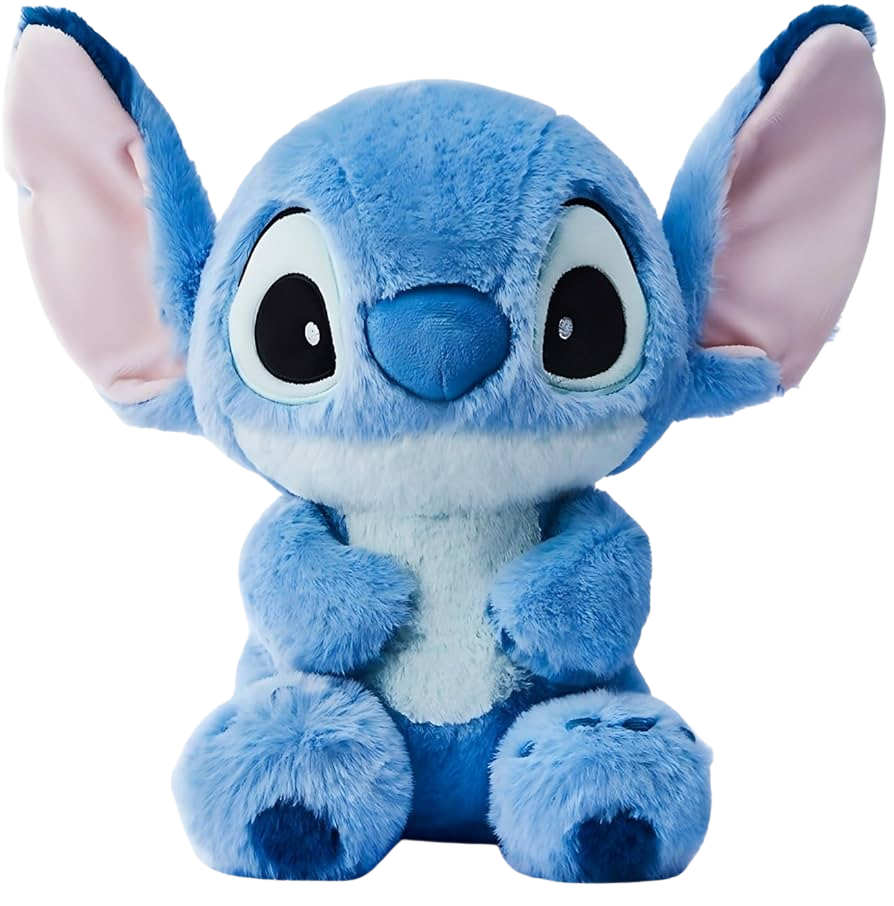
Stitch plush from Disney's Lilo and Stitch, one of the licensed characters anchoring Miniso's post-2018 US strategy.
Stitch. One of the licensed properties anchoring the second borrow, beginning 2018.

When the apology came, a second borrow was already four years deep. From 2018 onward, Miniso pivoted into licensed IP. Disney signed first, then Sanrio, Marvel, Warner Bros for Harry Potter, and Universal for the Minions. By 2026, Miniso had more than 180 global licensors and over 10,000 individual products moving through the pipeline annually.¹

The American borrow worked even faster than the Japanese one. By the end of 2025, around 275 US stores were generating roughly $400M in revenue at a 45% gross margin,¹ growing same-store sales in the low twenties despite tariff headwinds.¹¹

Year
Borrowed
Built on top
Proprietary attempt
2018
Licensed IP
Disney, Sanrio, Marvel, Warner Bros, Universal
275 US stores, $400M revenue, 45% gross margin
MINISO LAND, YOYO, TOP TOY

The brand had landed in America by leasing cultural permission from licensors stepping back from physical retail of their own. Sanrio had effectively wound down its directly-operated US retail in 2018, the same year Miniso began its licensed-IP push. Disney had been moving the same direction for years before announcing the closure of at least 60 of its North American stores in March 2021. Both companies wanted IP-shelf presence without the lease and the labor of running stores, and Miniso was the partner already serving that demand.

LICENSORS · US PHYSICAL RETAIL Sanrio winds down US direct Disney closes 60+ NA stores Licensed-IP push 200th store · Aug 2024 275 stores · $400M · end 2025 MINISO US STORES 2017 2018 2020 2021 2024 2025
2018 Sanrio winds down US direct retail; Miniso begins licensed-IP push.
2021 Disney closes 60+ North American stores.
2024 Miniso opens 200th US store (Aug).
end 2025 275 US stores · $400M revenue.

In 2026, at Disney's Consumer Products Division Launch Conference for Greater China, Tasia Filippatos, Disney's Consumer Products president, named Miniso among "partners who truly understand Disney's DNA." Pop Mart was named alongside Miniso in the same comment.

What Ye built on top of the borrows was real: the $10-and-under price discipline, the 100-new-items-per-week refresh cadence, the IP-zone merchandising layout, and the treasure-hunt basket-building experience. He won two of the hardest retail markets in the world by borrowing, twice, and each time he built a real store operation on top of someone else's brand. By 2025, the retail engine was generating about $360M in operating cash flow.¹ Whatever else is true about Ye, he can run stores.

The first engine is the licensed-IP retail operation. The second engine is what Ye is trying to build on top of it.

Imagine a competitor opens next door to the Miniso at 5 Times Square. Call it Major Yo. The Hello Kitty plush is the same. The Stitch keychain is the same. The Marvel mug is the same. The prices are the same. Who stays at Miniso?

The customer who knows Miniso for what is genuinely its own would stay. That customer values the price discipline, the refresh cadence, the merchandising layout. Those are real Miniso assets that have nothing to do with Disney.

The customer who walked in for the Hello Kitty would not stay. That customer would shop both stores and buy from whichever had the SKU they wanted that week.

The data tells us which customer is the larger one.

Across a sample of TikTok hauls in which Miniso products appear, most product mentions name only the licensor.²⁰ The retailer's name, when it is spoken at all, is usually read off the package.

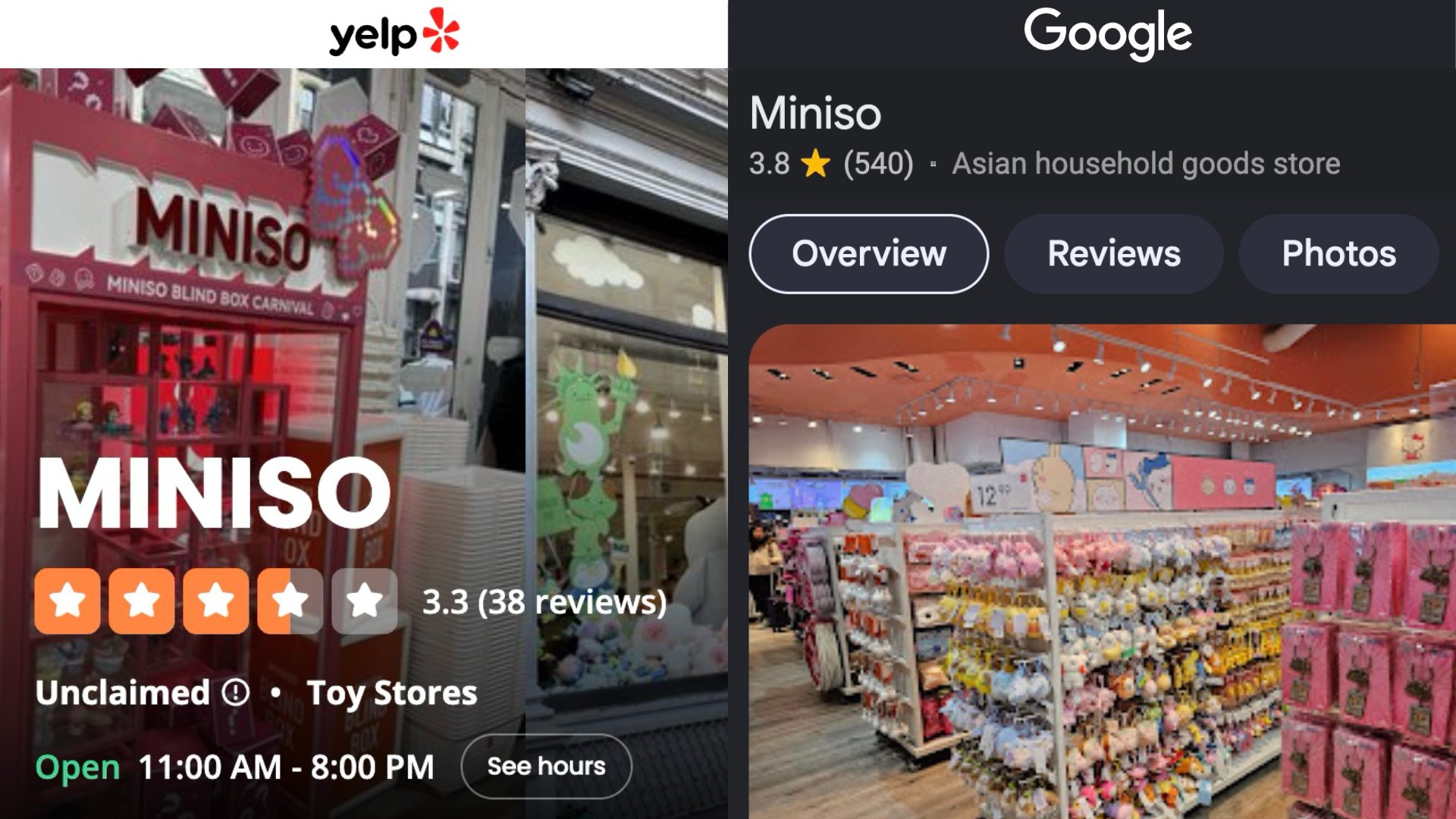
Yelp categorizes Miniso as a Toy Store. Google Maps categorizes Miniso as an Asian household goods store.

Yelp calls it a toy store. Google calls it an Asian household goods store. Neither calls it Miniso.

The customer locates Miniso between two other stores. One shopper described it as "a more upscale version of Daiso, but not quite as much stuff as Daiso."²²

Miniso is not a destination retailer. Major Yo would not be one either. At Pop Mart, the Chinese collectible-toy chain that owns Labubu, customers searching for Labubu find Pop Mart, because the character and the retailer are the same business.

What Miniso has become to consumers is visible in how they use the word. Reviewing a Sanrio store in Honolulu she found inauthentic, one Yelp reviewer described it as "feeling like a miniso than a true Sanrio store."²³ She is using the retailer's name as an adjective for a store pretending to be the real thing.

Ye knows this. In 2026, at the Global Partner Conference, he committed Miniso to becoming a "Global IP Operation Platform." The Super IP Strategy he laid out targets above 50% of revenue from IP product by 2028, with half of that coming from IP Miniso owns. That works out to about a quarter of total company revenue from owned IP, up from low single digits today.¹⁰

Pop Mart's founder, Wang Ning, took ten years to get to that position. In January 2016, the licensor Dreams terminated his exclusive distribution agreement for Sonny Angel, the Japanese designer-toy line that was Pop Mart's main product at the time. Wang Ning was 28 and out of a business.¹⁶ He pivoted to owned characters because the licensor had locked him out. By 2025, Pop Mart had revenue of about $5B at gross margins of 72.1%, with roughly 90% from IP Pop Mart owns.² As of May 2026, the market values the company at around $26B.³ Wang Ning got there because he had no other option. Ye has every option. That difference is what makes the comparison useful.

100% 50% 0% 2016 2019 2022 2025 Pop Mart 2025 · ~90% Miniso 2025 · low single digits
Pop Mart · ~90% of revenue from owned IP by 2025
Miniso · low single digits in 2024 to 2025

The proprietary moves Ye is making are real. They are also still domestic.

Exterior of a MINISO LAND flagship store in mainland China.
MINISO LAND storefront. The destination format. 26 stores in mainland China by end of 2025; none in America.

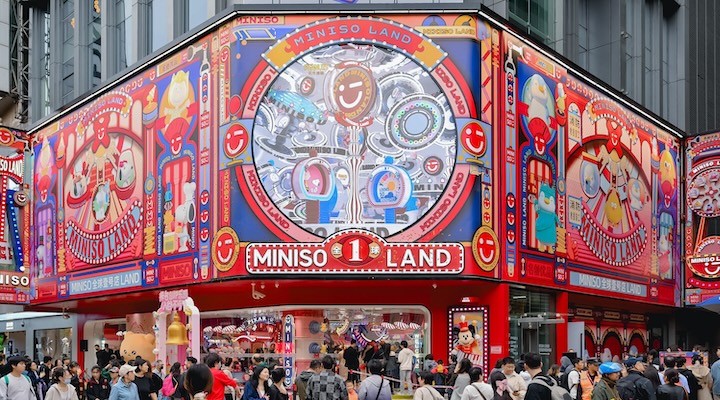
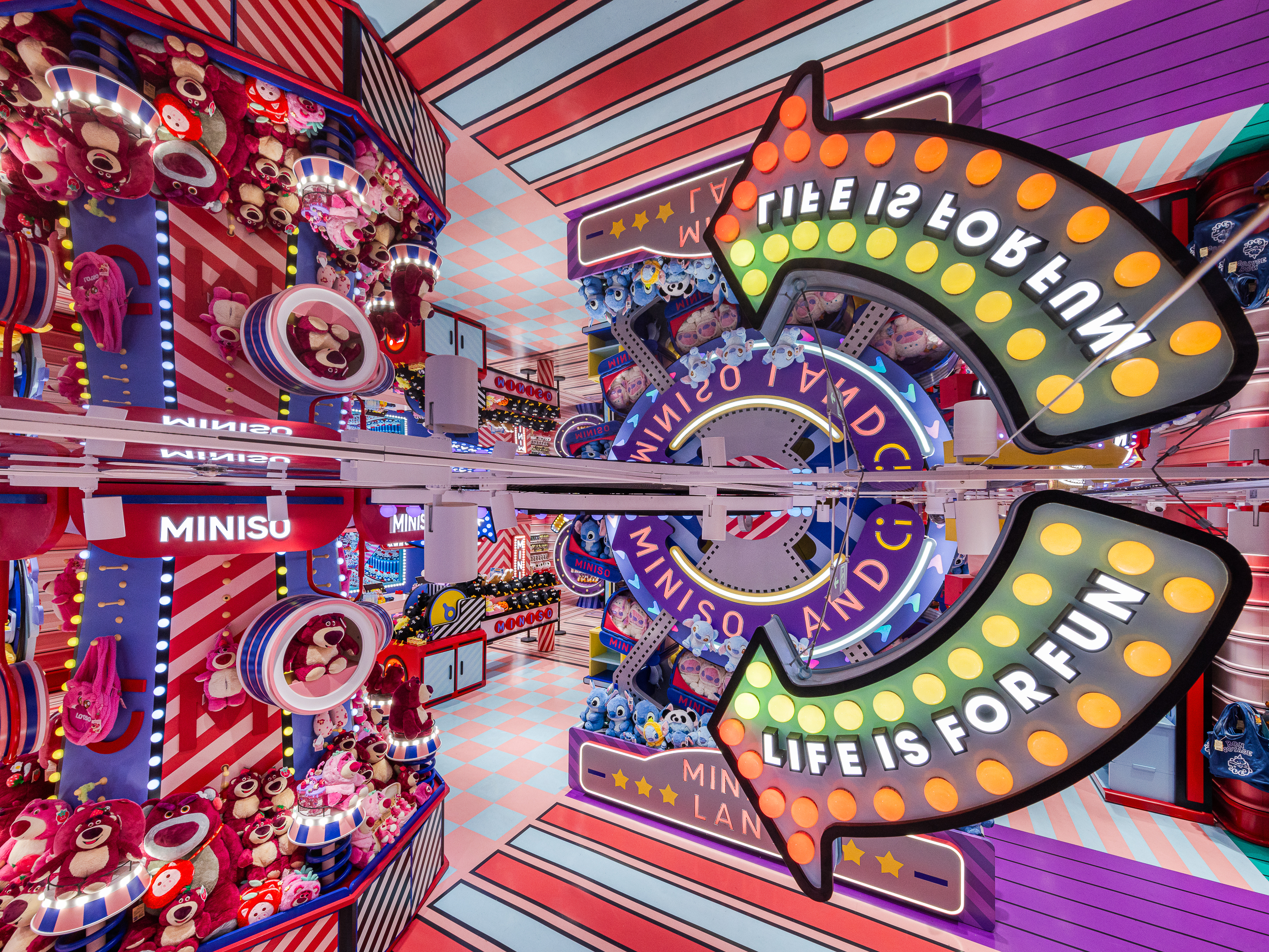
MINISO LAND is the destination format. By the end of 2025, 26 stores were operating in mainland China. At the Shanghai East Nanjing Road flagship, IP products accounted for 79.6% of revenue with a 35% to 40% repeat-purchase rate over the store's first nine months. In 2025 the format won Best New Store Concept at MAPIC, the international retail real-estate conference held in Cannes, and a MINISO SPACE flagship opened at Nanjing Deji that June. In China, the large-format stores are 10% of the store count but produce 20% of total sales.¹⁰ The Shanghai builds in particular are immersive theme-park-grade environments. Miniso is the host architecture. The licensors are themed zones inside.

MINISO LAND, Shanghai East Nanjing Road flagship
MINISO LAND, Shanghai East Nanjing Road · multi-floor · IP zones
MINISO LAND, Edmonton, opened November 2025
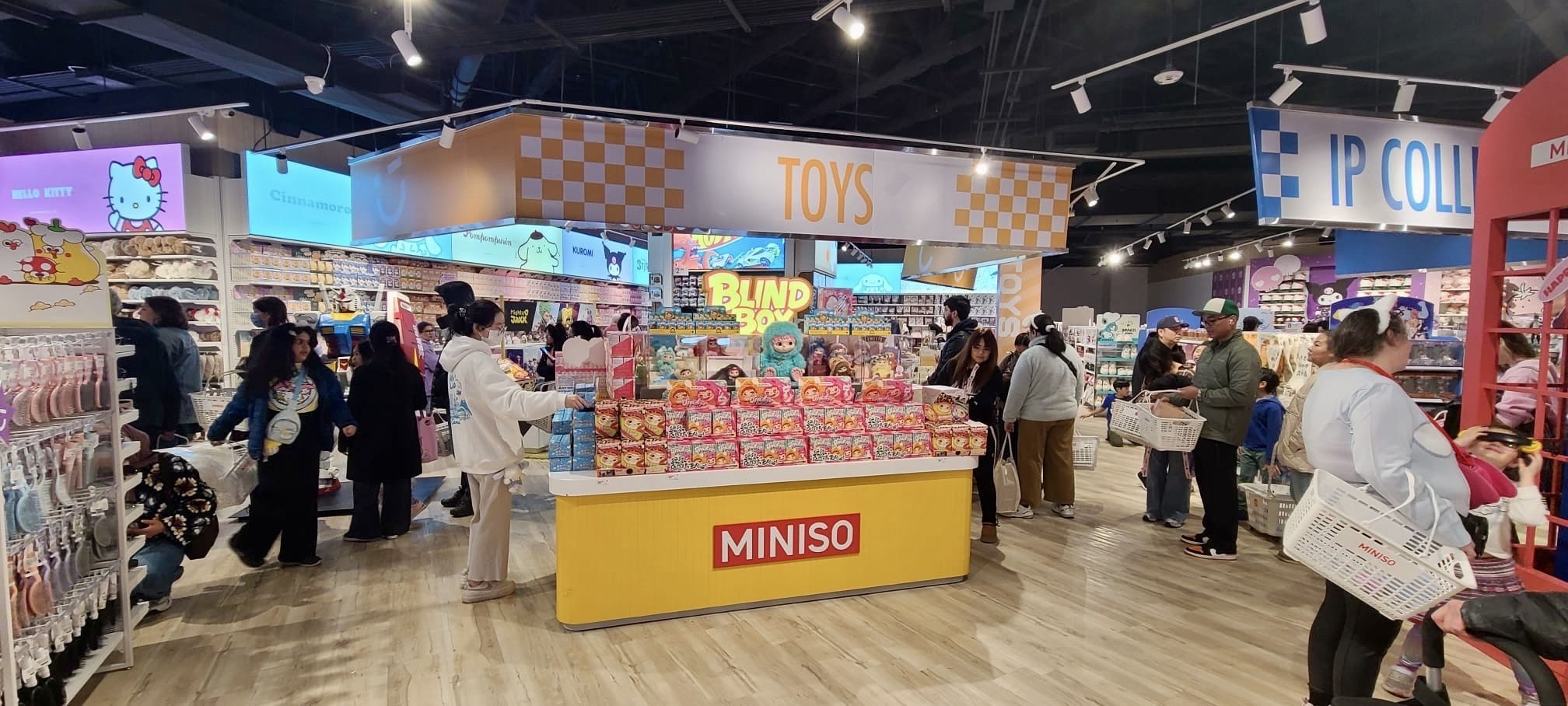
MINISO LAND, Edmonton Single floor · theme accents · attribution TK

Walk into the MINISO LAND at Edmonton, opened in November 2025, and the build is different. So are the ones in Singapore, Bangkok, and the other international rollouts to date.¹¹ They are larger Miniso footprints with theme accents on a few walls. None of them has the dedicated multi-floor immersive zones that define the Shanghai version. The Shanghai version of MINISO LAND has not been built abroad yet. The question is capital.

YOYO is the in-house character family Miniso launched in 2024. Revenue exceeded $14M in the first six months. Fiscal 2025 actuals came in at around $112M, the low end of internal projections. Combined with Gift Bear and Friends, DUNDUN, and Wakuku, the in-house portfolio is around 2-3% of group revenue.¹ Pop Mart's Monsters family, the line that includes Labubu, generated 38.1% of Pop Mart's total 2025 revenue alone.² YOYO is a fraction of one Pop Mart property.

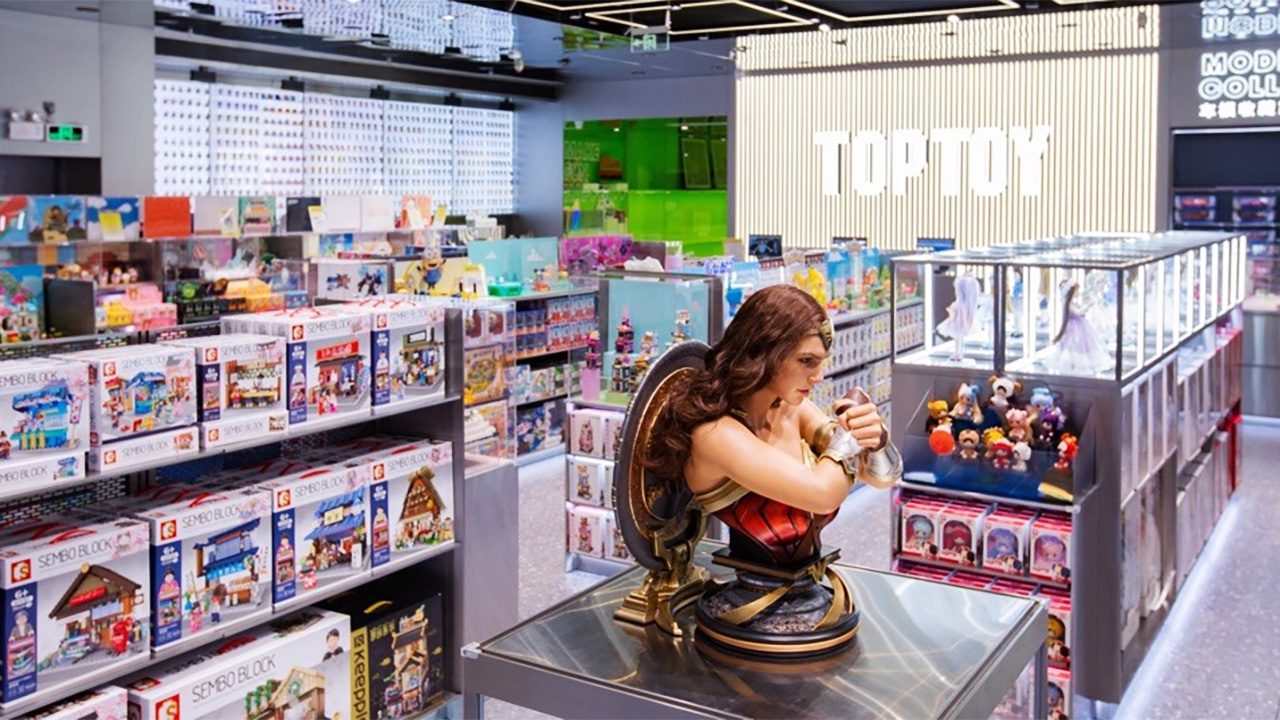
Interior of a TOP TOY store, the Miniso-owned blind-box collectibles chain in mainland China.
TOP TOY store interior. Started as a Pop Mart competitor; pivoted to licensed properties after the proprietary play stalled.

TOP TOY was originally an attempt to be Pop Mart inside Miniso, selling small mystery-packaged collectibles in the blind-box format Pop Mart pioneered, but the venture failed. The brand pivoted to licensed Sanrio, Disney, Winnie the Pooh, and Naruto. By late 2024 it was expanding into Thailand, Malaysia, Indonesia, and Japan. In April 2025, Sun Yuanwen, who runs the unit, told 36Kr that TOP TOY "lost money in a way that was just ugly," and that the most lucrative window for building original IP had already closed.¹² In July 2025, Temasek, Singapore's state investment fund, took a stake at a $1.3B valuation ahead of a planned public listing. Sunshine City Tokyo opened in August 2025. By year-end, the chain ran around 334 stores, 30 of them international.¹³ TOP TOY today is a licensed blind-box retailer carrying Sanrio, Disney, Winnie the Pooh, and Naruto, polished for international expansion and continuing the same pattern of borrowed material in a different form. The proprietary-IP play, for now, is on hold.

Pop Mart took ten years to build owned IP at scale. MUJI's modern arc spans roughly two decades, including a near-death deficit and a long aesthetic discipline rebuild under former CEO Tadamitsu Matsui.¹⁷ Uniqlo took eighteen years and two regional retreats before US profitability stabilized.¹⁸ Miniso's second engine is two to three years old.

Pop Mart
10 years
MUJI
~20 years
Uniqlo
18 years
Miniso
2 to 3 years

There are three real moves toward owning, each underfunded relative to the rented-IP engine that supports them. The retail engine throws off $360M in operating cash and $220M in free cash flow. Where does the capital go?

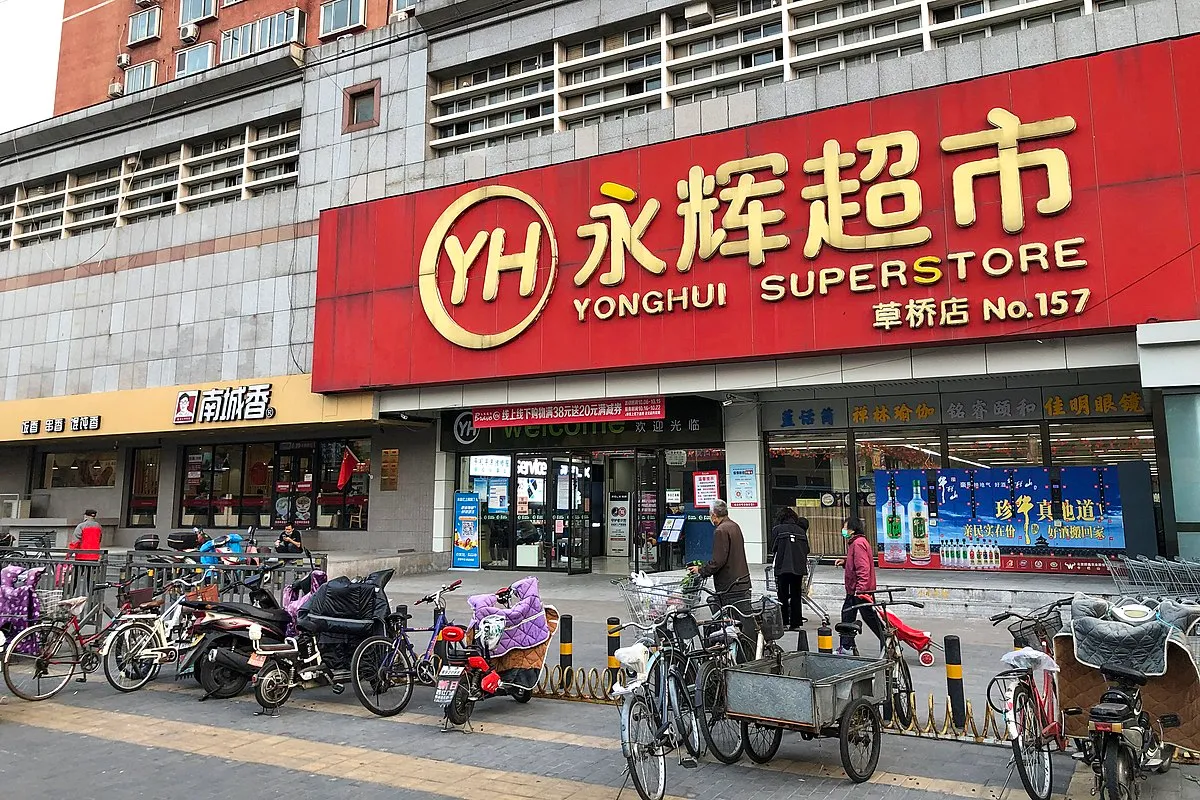
Exterior of a Yonghui Superstores supermarket in China, with the red 永辉超市 storefront sign.
Yonghui Superstores. Chinese fresh-grocery chain with more than 800 supermarkets. Miniso bought 29.4% in September 2024.

On September 23, 2024, Miniso announced it had paid about $860M for a 29.4% stake in Yonghui Superstores, the Chinese fresh-grocery chain with more than 800 supermarkets.¹⁴ On January 14, 2025, the company raised another $550M in convertible bonds at a 0.5% interest rate to help pay for the deal.¹⁵

The deal expanded Miniso's total debt from $430M to $1.5B and cut reported profit by 54%. About $113M of the cut came from Miniso's share of Yonghui's own losses. Another $39M came from interest on the convertible bonds and the bank loan funding the deal. A $22M paper loss on TOP TOY preferred shares rounded it out. The core retail engine still produced about $360M in operating cash flow and $220M in free cash flow.¹ The retail engine is fine. The Yonghui investment is the drag.

Year
Borrowed
Built on top
Proprietary attempt
2024
Distribution
29.4% of Yonghui's 800 supermarkets
The retail engine versus the Yonghui drag
$360M operating cash flow alongside the three components that cut reported profit by 54%
Operating Cash Flow
$360M RETAIL ENGINE
Drag on Reported Profit
$113M YONGHUI
$39M INTEREST
$22M TOP TOY

The retail engine produced $360M in operating cash flow. The Yonghui drag carved $174M out of reported profit elsewhere on the books.

Yonghui stake (29.4%)Sept 2024
$860M
MarvelDisney · 2009
$4.0B
LucasfilmDisney · 2012
$4.05B
PixarDisney · 2006
$7.4B
Pop MartMarket value · May 2026
$26B

The strongest version of Ye's defense goes beyond the hedge thesis. It says:

I am the world's best operator of borrowed IP at scale.

Disney calls me a partner that understands its DNA. Sanrio renewed.

The thesis that says I should become Pop Mart misreads what I am.

I should be the global rail for everyone's IP, Pop Mart's included.

Yonghui adds 800 channels to that rail.

I have flexibility, choices, and access to a category I have been kept out of.

That is a coherent argument. A reader sitting in Ye's chair can defend it.

Look again at what Yonghui actually is.

Year
Borrowed
Built on top
Proprietary attempt
2024
Distribution
29.4% stake in 800 channels Yonghui operates. Not 800 channels Miniso owns.

Yonghui is not 800 channels Miniso owns. Yonghui is a 29.4% stake in 800 channels Yonghui operates. Ye is borrowing distribution. He is borrowing a grocery rail. He is borrowing a category and a customer flow Miniso has never run before. The asset class changes; the pattern does not.

The timing of the Yonghui decision carries an argument of its own. The decision, made in September 2024, was made when the second engine was less than three years into its build. By Pop Mart's clock, that is fiscal 2018. By MUJI's, the early years of the Matsui rebuild. By Uniqlo's, while the US fleet was still losing money. None of those engines would have been visible by the metrics available at that point. Ye made the call before the call could have been called, which is a different problem from making the wrong call.

The opportunity cost is visible in what $860M can buy at this scale. Pop Mart's market value is roughly $26B.³ Disney bought Marvel for $4B in 2009, Lucasfilm for $4.05B in 2012, and Pixar for $7.4B in 2006.¹⁹ The Yonghui $860M does not buy a Pop Mart. It can buy a second-tier character family or an artist-IP studio at scale. It can fund a Shanghai-grade MINISO LAND in New York or Los Angeles. The capital that could have funded the second engine is now invested in fresh grocery.

Miniso has built the most operationally sophisticated borrowed-IP retail operation in American history. It has not yet deployed that capability toward owned assets.

The stated ambition is to own. Every observable major capital decision is to borrow. He borrowed Japanese aesthetic to enter China. He borrowed Disney and Sanrio to enter America. He borrowed Yonghui to enter grocery. The asset class changes; the pattern does not.

Three rotations, one column refilled
The instrument the piece has been showing you all along
2013
Borrowed
Japanese aesthetic
Built on top
$2 ASP · $5 basket
Proprietary
(empty)
2018
Borrowed
Disney, Sanrio, Marvel, Warner, Universal
Built on top
275 US stores · $400M · 45% GM
Proprietary
MINISO LAND · YOYO · TOP TOY (2-3%)
2024
Borrowed
Yonghui · 29.4% of 800 supermarkets
Built on top
(empty)
Proprietary
(empty)
The asset class changes.
The Borrowed column does not.

The piece does not render a verdict on the Yonghui call. The bet is genuinely live. Ye has every option Wang Ning didn't have. The next three to five years will tell us whether the Yonghui purchase was a hedge that paid off or a misallocation that delayed the second engine by a decade. Neither the writer nor the reader knows yet.

Here is what to watch over the next twenty-four months.

Three moves would tell us the second engine is being funded. The first is a MINISO LAND opening in New York or Los Angeles at Shanghai grade. That kind of build requires hundreds of millions of dollars for a single flagship, not a larger Miniso footprint with theme accents on a few walls. The second is an acquisition of an artist-IP studio or a second-tier character family at scale, calibrated to Miniso's balance sheet rather than another licensing renewal. The third is YOYO and the rest of the in-house family climbing to ten percent or more of group revenue, up from two to three percent today. That would mean the proprietary moves had grown past run-rate and were competing with the rented-IP engine for shelf space and merchandising attention.

Three other moves would tell us the second engine has stalled. The first is YOYO and the in-house family staying flat at two to three percent of revenue while the rented-IP engine keeps growing. The second is another stake in an adjacent category, treated as a hedge and paid for by pulling more cash from the retail engine. The third is MINISO LAND staying Shanghai-only, with US flagship plans deferred or downsized.

Engine being funded
Engine not being funded
Stalled Funded

Borrowing is one of eight ways a Chinese brand can enter America. It is the fastest path in. It does not build defensibility. Borrow got him in twice. The most recent major capital decision was another borrow. Whether the next one is too is the only question that matters.

The Question
Borrow got him in.
Twice.
Whether the next one is too is the
only question that matters.

METHODOLOGY NOTES

²⁰ The TikTok haul observation reflects a hand-coded sample of US TikTok content in which Miniso-purchased products appear, conducted by Asia Aisle in March and April 2026. Product callouts were transcribed manually from video. This is not a formal survey or an automated speech-recognition study. The pattern noted reflects the sampled population only.

The Yelp and Google Maps category labels for Miniso are observable as of April 2026 and were verified directly. The reader can verify the same labels independently.

The "Major Yo" thought experiment in Section IV is a hypothetical, not a forecast. It is offered to make the contestability of borrowed customer demand visible, not to predict an entrant.

The "What Ye would say" block is the writer's reconstruction of the strongest version of Ye's publicly stated position, drawing on his Group Partner Conference statements (¹⁰) and Miniso's investor disclosures. It is not a direct quotation.

The watch list in the closing section is Asia Aisle analytical inference about which observable moves in the next 24 months would constitute evidence one way or another about whether the second engine is being funded. It is a reading frame, not a forecast.

The Yonghui drag decomposition ($113M Yonghui losses, $39M interest, $22M TOP TOY paper loss) is sourced from Miniso's FY2025 annual results announcement (¹). The categorization of components reflects the company's own disclosure.

The signage-hierarchy renderings in the opening and closing sections are designed editorial illustrations of an observable real-world arrangement at the 5 Times Square Miniso storefront. They are schematic, not photographic. The relative sign sizes reflect the writer's observed dominance of licensor branding over the Miniso wordmark; they are not measured pixel-by-pixel from a single photograph.

Sources

¹ Miniso Group FY2025 Annual Results announcement, March 31, 2026 (NYSE: MNSO; HKEX: 9896).

² Pop Mart 2025 Annual Results, March 25, 2026, filed Hong Kong Stock Exchange (9992.HK).

³ PitchBook Public Comps; companiesmarketcap.com, retrieved May 2026.

Reuters, "Chinese retailer Miniso to ditch Japanese styling after backlash," August 18, 2022. Vice, "Chinese Discount Retailer Miniso Is Sorry for Pretending to Be Japanese," August 2022. Global Times, August 10, 2022.

Peter Hays Gries, "China's 'New Thinking' on Japan," The China Quarterly 184, Cambridge University Press, 2005.

Miniso press release, August 2024. Opening of the 200th US store in Santa Monica.

Disney Consumer Products Division Launch Conference for Greater China, 2026.

The Walt Disney Company corporate announcement, March 2021.

Industry coverage, 2018. Sanrio Inc. wind-down of directly-operated US retail.

¹⁰ Miniso Group Global Partner Conference disclosures, 2024 and 2025.

¹¹ Miniso Group Q4 2025 earnings call transcript, April 2, 2026.

¹² 36Kr, April 2025. Sun Yuanwen, head of TOP TOY.

¹³ Temasek Holdings stake announcement, July 2025.

¹⁴ Miniso Group transaction disclosure, September 23, 2024.

¹⁵ Miniso Group convertible bond offering circular, January 14, 2025.

¹⁶ Pop Mart IPO prospectus (Hong Kong Stock Exchange, December 2020).

¹⁷ Ryohin Keikaku Co. Ltd. annual reports and trade press coverage.

¹⁸ Fast Retailing Co. Ltd. annual reports and trade press coverage.

¹⁹ The Walt Disney Company corporate transaction announcements.

²⁰ Asia Aisle field observation, March to April 2026. See Methodology Notes.

²¹ @TokyoFashion, X (formerly Twitter), August 19, 2022.

²² Yelp brand-page review for Miniso, retrieved April 2026.

²³ Yelp review of Sanrio Surprises, Kahala Mall, Honolulu, HI 96816, retrieved April 2026.
Asia Aisle · The Borrow · 2026